mtu 12V2000Z
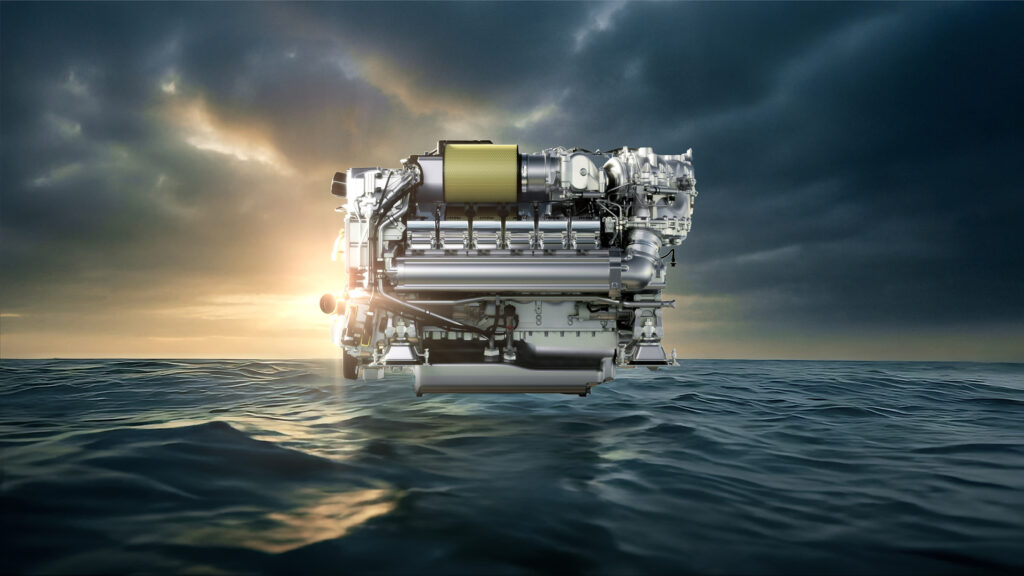
New 2000 mtu engine from Rolls-Royce with more power for fast ships and yachts: Power output increases from 1,472 kW (2,002 hp) to 1,634 kW (2,222 hp). This takes power density to a new level, with only minor differences in weight and dimensions compared to the previous 12V 2000 M96X model. Neuer 2000-er mtu-Motor von Rolls-Royce mit mehr Leistung für schnelle Schiffe und Yachten : Die Leistung erhöht sich von bisher 1.472 kW (2.002 PS) auf 1.634 kW (2.222 PS). Die Leistungsdichte steigt damit auf ein neues Niveau, mit nur geringfügigen Abweichungen bei Gewicht und Abmessungen gegenüber dem Vorgängermodell 12V 2000 M96X.
Rolls-Royce presents new mtu engine with 2222 hp and integrated bridge system for series-production yachts
mtu 12V2000Z-Rolls-Royce is further expanding its portfolio of mtu yacht solutions “From Bridge to Propeller”. At the “Cannes Yachting Festival 2025”, Rolls-Royce’s Power Systems division will present the advanced mtu 12V2000Z engine with 2222 hp to the public for the first time. With a new mtu NautIQ Bridge for yachts between 30 and 40 metres in length, the company now also offers fully integrated bridge solutions for large series yachts. In addition, Rolls-Royce is introducing a new, even more flexible exhaust aftertreatment system in combination with the mtu 4000 series engines. A fuel-efficient POD drive completes the “From Bridge to Propeller” offering.
Denise Kurtulus, Senior Vice President Global Marine at Rolls-Royce Power Systems says: “The aim of ‘Bridge to Propeller’ is to build and operate large yachts as efficiently, safely, climate-friendly and cost-effectively as possible. The individual components – bridge, engine and POD – and the coordinated complete systems are designed precisely for this purpose. With our unique complete offering, we have positioned ourselves extremely successfully in the yacht market.
With the new mtu NautIQ Bridge for vessels between 30 and 40 metres in length, manufacturers, owners and crews of series-produced yachts can now also benefit from the advantages that an integrated bridge system offers over traditional bridge solutions. The bridge platform, which is tailored to the requirements of series-produced yachts, builds on the experience gained by bridge specialist Team Italia Marine, which was acquired by Rolls-Royce two years ago, in equipping large superyachts. It integrates numerous instruments that are often operated individually for monitoring and operating a yacht into a single unit – from monitoring the entire powertrain to navigation, weather forecasting and radio technology to the alarm system – and is prepared for the use of future systems.
Christian Paolini, Managing Director and Sales Manager at Team Italia Marine says: “The mtu NautIQ Bridge not only represents the state of the art in technology, but is also designed to allow the integration of new functions such as artificial intelligence systems. This means that a yacht is already fit for the future of yacht control and automation.
The new 12-cylinder engine in the mtu 2000 series for yachts and other fast vessels offers maximum power of 2,222 hp (1,634 kW) in a very small space. The engine, with the exact designation 12V2000 M96Z, is 220 hp (162 kW) more powerful than its predecessor. This takes power density to a new level, as the dimensions and measurements are virtually unchanged from the previous 12V 2000 M96X model. To achieve these new peak values, the turbochargers have been further developed for powerful acceleration with low exhaust emissions, the crankcase and cylinder heads have been improved, and new pistons have been developed. Like all mtu yacht engines, the 12V2000 M96Z is approved for operation with the sustainable fuel HVO (hydrogenated vegetable oil). IMO II and EPA Tier 3 recreational certifications are possible.
Denise Kurtulus expressly recommends this fuel for sustainable yacht operation: “With this hydrogenated vegetable oil, a CO2 reduction of up to 90 per cent is already possible. We are convinced that there is no alternative to the combustion engine in the yacht market in the foreseeable future if performance and range requirements are to be met. The fuel used is the alternative, and that is currently HVO, which is now available in many ports. Many yacht captains and owners have already had excellent experiences with HVO. We have tested it extensively on our test benches and can confirm that mtu engines can run on it without any problems.”
In the longer term, Denise Kurtulus favours methanol, but regrets that green methanol, i.e. methanol produced with the help of renewable energy, is not yet widely available. Kurtulus: “Rolls-Royce is continuing to work on the development of a methanol engine. “When green methanol is available as an alternative fuel in the required volume, we will have the right engine for it,” emphasises Kurtulus. The market for such engines is currently limited to pilot applications.
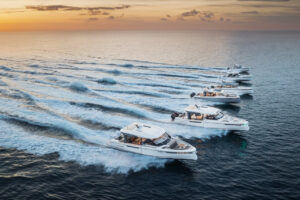
The third component of the “Bridge to Propeller” concept, the POD drive, is also designed entirely for efficiency. The compact drive combines the gearbox and rudder system and reduces fuel consumption by up to 20 per cent. In addition, the POD improves the manoeuvrability of the ship. The combination of mtu engine and POD has already gone into series production: At the Cannes Yacht Show, Italian yacht manufacturer Azimut is presenting its “Grande 30” model for the first time, in which such a coordinated system ensures high performance, comfort and efficiency. This solution is the result of intensive collaboration between Azimut and Rolls-Royce, which included extensive testing of the entire propulsion system on a special test bench at the Rolls-Royce factory.